1 February 2023
New Simulation Center Makes High-Quality Nursing Education Available to More Students
Category


New Simulation Center Makes High-Quality Nursing Education Available to More Students
The COVID-19 pandemic has created staffing shortages across Michigan hospitals, especially among nurses. Rural hospitals are the hardest hit as they struggled to meet adequate staffing levels even before the pandemic. Maintaining a low nurse-to-patient ratio is key to safer patient care and improved outcomes. However, nursing schools cannot graduate enough nurses to keep pace with demand. To resolve this issue, Alpena Community College (ACC) in northeast Michigan uses simulation in its nursing education program to help train more nurses and ensure they can provide better care for patients across the region and beyond.
A lack of nursing education contributes to shortages
Nursing shortages were a problem in many states, including Michigan, even before the pandemic hit. Several factors contributed to this problem, but the most significant is the shortage of clinical training sites where nursing students get hands-on practice performing various procedures and providing patient care[1].
Clinical experiences are essential to effective nursing education because they allow students to apply what they have learned in the classroom hands-on. Adults learn best by doing and then reflecting on their actions. Clinical training sites enable students to interact with patients and engage in critical thinking as they make clinical decisions and work as a team.
Moreover, students work under the supervision of clinical preceptors, so they receive feedback on their actions and learn how to improve their performance. These experiences build on students’ knowledge and give them their first taste of working in high-stress environments. Thus, students develop the skills and confidence needed to provide effective care when they enter the workforce.
However, the nursing faculty workforce is rapidly aging; about one-third will retire by 2025[2], creating faculty shortages that force nursing schools to limit student capacity and have fewer clinical training sites. This degrades the student-to-nursing workforce pipeline that provides qualified staff for hospitals and training sites.
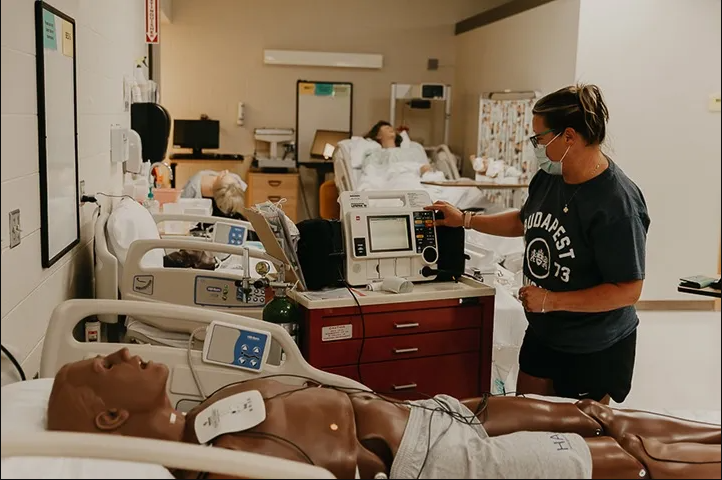
Therefore, ACC invested in constructing a new nursing wing to address this issue. The new wing opened in 2021, following a two-year renovation of Van Lare Hall. The new wing established a simulation training space dedicated to nursing. ACC also used funding from the Strengthening Institutions Program Grant to purchase four new high-fidelity patient simulators to help provide comprehensive nursing skills training.
According to ACC Nursing Program Director Melissa Fournier, the simulators will provide students with more realistic preparation for real-world nursing before and during clinical rotations. The goal is to ensure students have a place to safely gain the experience needed to build clinical competence and confidence. Thus, ACC can train more highly qualified nurses to fill staffing needs across northeast Michigan.